Data versus Phenomena
Should theories answer to stable phenomena, to the data we observe, or to both?
Psychological studies do not give theories their targets directly. They produce data: observations generated by particular people, tasks, instruments, and analysis choices. These observations may be reaction times, brain activations, or questionnaire ratings. From them, researchers infer phenomena: stable patterns that recur across studies and that theories aim to explain, such as the speed-accuracy trade-off, the power law of practice, or mood recovery after a setback. Bogen and Woodward's data-phenomena distinction (1988) marks the gap between these two levels. Phenomena give theories their explanatory targets, while data provide the evidence through which those targets are identified and tested. The current debate is about how these two levels should work together in evaluating theories.
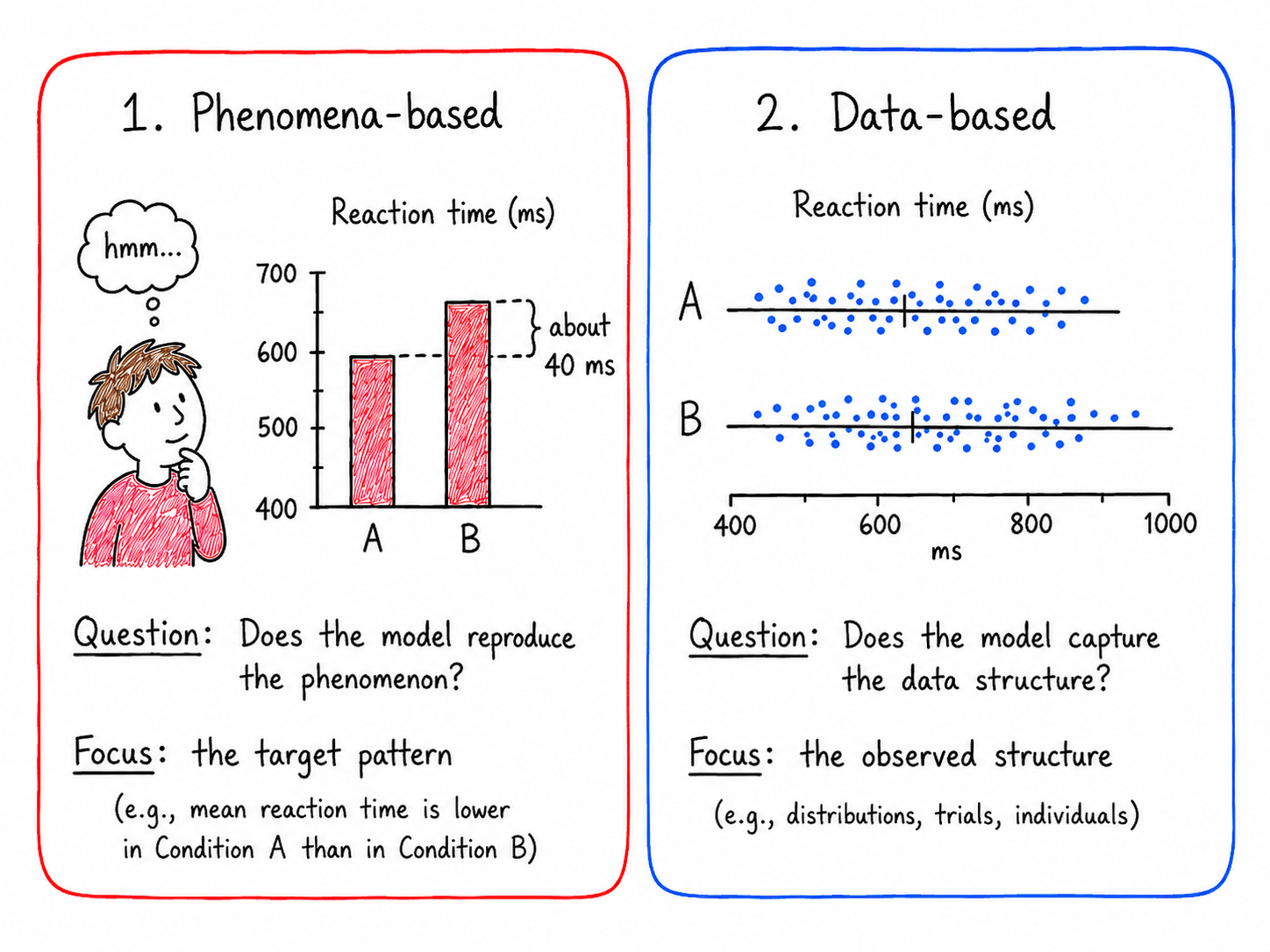
Consider a reaction-time study in which people are 40 ms slower in one condition than another. A phenomenon-based test might ask whether a model can reproduce that mean difference. That is a meaningful question, but it may not be enough. The same average could reflect a small slowing for nearly everyone, a subgroup shifting from fast guesses to deliberate responses, slower evidence accumulation that stretches the right tail of the distribution, or a few lapses that pull the mean upward. These are different psychological mechanisms, even though they produce the same headline result. Looking at the full data structure can therefore reveal distinctions that the summarized phenomenon leaves open.
But fit to data is not the whole answer either. A flexible model might predict the reaction times well by learning who is generally fast, which items are slow, how responses change over the session, and which trials look unusual. That fit is useful, but it does not by itself explain what changed between conditions. The explanation still depends on a theoretical claim about the mechanism, such as response caution, evidence accumulation, strategy use, or attention. The debate, then, is not whether data or phenomena are the right target. It is about how they constrain each other. Phenomena specify what a theory is trying to explain, and data show whether the model captures the structure through which that phenomenon appears. The readings below trace this debate from Bogen and Woodward's distinction to recent work arguing for this integrated view.
No Need to Be Indirect: On the Role of Data in the Validation of Theoretical Models
Vanhasbroeck, N., Yu, K., & Ariens, S. · Theory & Psychology · 2026
Vanhasbroeck, Yu, and Ariens challenge the increasingly popular view that formal psychological theories should be validated against phenomena alone, and make the case for bringing data back into theory testing. They show that neither phenomena nor data are a sufficient basis on their own, and propose an integrative approach in which the two play complementary roles.
- A single phenomenon rarely distinguishes competing models: many different mechanisms can produce the same mean difference.
- Phenomena alone give no principled way to judge a model's complexity, and reasoning from them becomes circular when the phenomenon itself is mis-specified.
- Pure data-fitting has its own blind spots: auxiliary assumptions, estimability, and atheoretical models that often fit better than explanatory ones.
- Their integrative loop pairs top-down prediction of phenomena with bottom-up analysis of the full data structure, illustrated by the 19th-century discovery of Neptune.
APA
Vanhasbroeck, N., Yu, K., & Ariens, S. (2026). No Need to Be Indirect: On the Role of Data in the Validation of Theoretical Models. Theory & Psychology. https://doi.org/10.1177/09593543261450876
Foundations: data vs phenomena
-
APA
Bogen, J., & Woodward, J. (1988). Saving the Phenomena. The Philosophical Review. https://doi.org/10.2307/2185445
APA -
APA
Woodward, J. (1989). Data and Phenomena. Synthese. https://doi.org/10.1007/BF00869282
APA
Phenomenon-based theory construction
-
APA
Borsboom, D., van der Maas, H. L. J., Dalege, J., Kievit, R. A., & Haig, B. D. (2021). Theory Construction Methodology: A Practical Framework for Building Theories in Psychology. Perspectives on Psychological Science. https://doi.org/10.1177/1745691620969647
APA -
APA
Haslbeck, J. M. B., Ryan, O., Robinaugh, D. J., Waldorp, L. J., & Borsboom, D. (2022). Modeling Psychopathology: From Data Models to Formal Theories. Psychological Methods. https://doi.org/10.1037/met0000303
APA -
APA
van Dongen, N., et al. (2025). Productive Explanation: A Framework for Evaluating Explanations in Psychological Science. Psychological Review. https://doi.org/10.1037/rev0000479
APA -
APA
Haig, B. D. (2005). An Abductive Theory of Scientific Method. Psychological Methods. https://doi.org/10.1037/1082-989X.10.4.371
APA
Data, prediction & the theory crisis
-
APA
Navarro, D. J. (2019). Between the Devil and the Deep Blue Sea: Tensions Between Scientific Judgement and Statistical Model Selection. Computational Brain & Behavior. https://doi.org/10.1007/s42113-018-0019-z
APA -
APA
Yarkoni, T., & Westfall, J. (2017). Choosing Prediction Over Explanation in Psychology: Lessons From Machine Learning. Perspectives on Psychological Science. https://doi.org/10.1177/1745691617693393
APA -
APA
Vanpaemel, W. (2020). Strong Theory Testing Using the Prior Predictive and the Data Prior. Psychological Review. https://doi.org/10.1037/rev0000167
APA -
APA
Eronen, M. I., & Bringmann, L. F. (2021). The Theory Crisis in Psychology: How to Move Forward. Perspectives on Psychological Science. https://doi.org/10.1177/1745691620970586
APA -
APA
van Rooij, I., & Baggio, G. (2021). Theory Before the Test: How to Build High-Verisimilitude Explanatory Theories in Psychological Science. Perspectives on Psychological Science. https://doi.org/10.1177/1745691620970604
APA